

Byung-Chul Han awarded an honorary doctorate by Ramon Llull University

The distinction, jointly proposed by La Salle-URL’s School of Architecture and Faculty of Philosophy, recognises the decisive contribution of one of the leading voices in contemporary thought
Wednesday, 18th November 2026. Byung-Chul Han, thinker and essayist, has been awarded an honorary doctorate by Universitat Ramon Llull (URL), proposed by La Salle-URL’s School of Architecture and Faculty of Philosophy. During the ceremony, held on Tuesday 17 November at the Basilica of Santa Maria del Mar in Barcelona, Han delivered a masterclass entitled The Architecture of the Soul, exploring some of the key ideas underpinning his thought.
The ceremony was attended by Carles Pérez Testor, Rector of URL; Lluís Recoder, President of URL; Bro. Josep Espuny, President of FUNITEC La Salle-URL; Jesús Vilar, Secretary General of the University, and the rest of the members of the URL Rector's Team; Josep M. Santos, Director General of La Salle-URL; and the academic sponsors of the honorary doctorate ceremony, Josep Ferrando, Director of the La Salle-URL School of Architecture, and Carles Llinàs, Dean of the La Salle-URL Faculty of Philosophy. The ceremony was also attended by Jaume Padrós and Fransina Alsina, members of the URL Board of Trustees, and Jordi Riera, Director General of Blanquerna-URL.
In addition to the members of the University's governing bodies, the ceremony brought together institutional representatives and members of the civil society, including Miquel Soriano, Director General for Universities of the Government of Catalonia; Ramon Bassas, Director General for Religious Affairs of the Government of Catalonia; Elmar Jakobs, Consul General of Germany in Barcelona; Meritxell Ruiz, Secretary General of the Christian School Foundation of Catalonia; Miquel Gómez, Director General of the Catalan Foundation for Research and Innovation (FCRI); and Raimund Herder, Director of Herder Editorial.

The honorary doctorate ceremony began with the opening of the event by Carles Pérez Testor, Rector of URL, who said: “The solemn ceremony conferring the degree of Doctor Honoris Causa upon Byung-Chul Han, philosopher and essayist, by the Ramon Llull University, is now open. We do so in this incomparable setting, the Basilica of Santa Maria del Mar, a jewel of fourteenth-century Catalan Gothic architecture. I would like to express my gratitude to the parish community and its rector, Fr. Salvador Pié, for welcoming us here today.”
In one of the most solemn moments of the ceremony, Byung-Chul Han entered the Basilica accompanied by his two academic sponsors to the sound of the Adagio from Johann Sebastian Bach’s (1685-1750) Concerto in A Minor, performed by the La Salle-URL Choir of Barcelona under the direction of Joan Cabó, professor of philosophy at the faculty and organist of the Basilica.

In his speech, Han explored the relationship between architecture and the soul, and argued that physical spaces, symbols, and rituals help shape the way we inhabit the world and give meaning to life. “Architecture and the soul condition one another; they reflect each other or even generate one another,” the philosopher stated.
Building on this idea, Han warned that the acceleration of information and digitalization make it difficult to build stable points of reference and weaken the symbolic structures that provide us with guidance. “Digitalization accelerates the demolition of the architecture of the soul,” he cautioned.
The philosopher also pointed out the consequences of individualism and the erosion of community ties, and emphasizedthe importance of shared narratives for building a life in community. In this regard, he noted that one of the essential functions of creating a home is “to enable the soul to become part of a community and take root.”

Philosophy and architecture: two perspectives on rethinking how we inhabit the world
In his laudatio, Carles Llinàs highlighted Han’s ability to interpret the contradictions of contemporary society, from the consequences of neoliberalism and technological acceleration to the loss of reference points, community bonds and meaning. The Dean of La Salle-URL’s Faculty of Philosophy also identified hope as a key horizon in Han’s thought, recalling that his diagnosis of reality opens up the possibility of finding “a new way of inhabiting and thinking about the world that is in keeping with human beings”.

On his side, Ferrando highlighted the architectural scope of Han’s thinking, particularly regarding issues such as the disappearance of rituals, the relationship with the material world, and the need to claim for spaces for contemplation and encounter. The director of the La Salle-URL School of Architecture has advocated for a conception of the discipline that goes beyond the mere construction of buildings. “Byung-Chul Han’s thinking does not provide architectural solutions, and this is precisely where much of its value for us lies. It provides us with something that comes first and is perhaps more important: questions”.
The rector of the URL, Carles Pérez Testor, closed the event by emphasizing that Han’s work invites us to reflect on some of the great paradoxes of contemporary society. “We need to preserve spaces for conversation, for listening, for contemplation, and for those questions that do not immediately seek a practical answer, but rather help us better understand who we are and what kind of world we want to build,” said the rector of Ramon Llull University.

In the conclusion of his speech, Pérez Testor explored in depth the concepts of “bienser”—understood as a full, meaningful life lived in community with others—and “hope.” In this regard, he stated that, after listening to Professor Han, “we could say that “bienser” also requires an architecture of the soul: time, spaces, connections, and rituals that allow us not only to live well, but to inhabit our own lives with meaning.” In this regard, he emphasized that, beyond academic education, the role of the university is “not merely to train competent individuals and good professionals, but also to contribute to their “bienser”. To educate people capable of thinking, loving, creating, caring for others, and finding meaning in what they do.”
AN AWARD THAT BRIDGES DISCIPLINES AND OPENS UP NEW PERSPECTIVES
For the first time in its history, Ramon Llull University has awarded an honorary doctorate based on a joint proposed from two URL faculties. The Architecture and Philosophy initiative at La Salle-URL highlights the value of connecting disciplines to understand society’s challenges and reinforces an educational model in which technology, knowledge, and humanism engage in dialogue to open up new perspectives. This approach places people at the center and affirms the university’s ability to challenge the status quo from asking questions to helping build a more just and sustainable society.

HIGHLIGHTED POSTS ON SOCIAL MEDIA
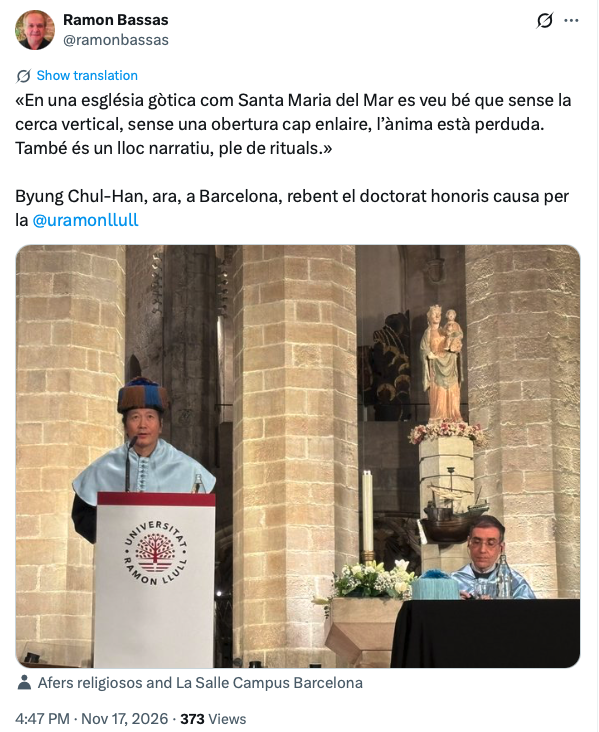
The event has also sparked various reactions on social media. Among the most notable, Ramon Bassas, director general of Religious Affairs for the Generalitat of Catalonia, shared a tweet on X about Byung-Chul Han’s inauguration at the Basilica of Santa Maria de Mar.
On his side, Jaume Padrós, a member of the board of trustees and chair of the Advisory Council for the Blanquerna-URL Bachelor’s Degree in Medicine, described Han as “South Korean but German, a philosopher, and a Catholic” noting that the thinker’s speech was “sublime.”
Additionally, Cataluña Cristiana reported on the ceremony, highlighting Byung-Chul Han’s conferral of an honorary doctorate by Ramon Llull University and emphasizing the thinker’s international stature, describing him as “one of the most cited philosophers of the last decade.”
DOWNLOAD PHOTOS FROM THE EVENT HERE!
MORE INFORMATION
Clàudia Arderiu Pujadas
Office of Communications and Institutional Relations
Office of the URL Rector
Tel. 93 602 22 26 | 692 671 597
You may also be interested in


L’adhesió com a membre de ple dret obre noves vies de cooperació en recerca, conservació del patrimoni científic i divulgació amb una trentena d’institucions de deu països

L’Andrea estudia el grau en Relacions Internacionals a la Facultat de Comunicació i Relacions Internacionals Blanquerna-URL
